
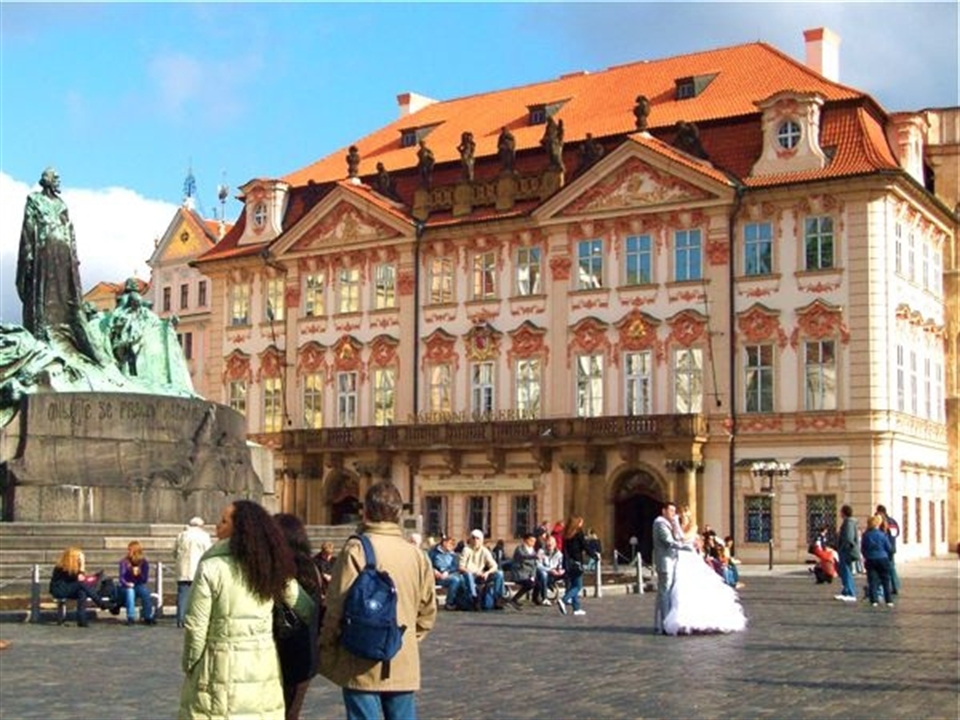
Rococo came about in late 18th century Continental Europe as the late Baroque style fused together with French elements. The word Rococo comes from the Italian Barocco or Baroque combined with the French rocaille, or shell. The main characteristics of Rococo are shell like curves, elaborate, ornate decorations featuring motifs and asymmetrical scrollwork, and an overall complete feel, as rooms were decorated as total works of art combining fancy furniture, sculptures, tapestries, decorative mirrors, reliefs and wall paintings. Rococo was replaced by the neoclassic style.
In 1420 a mob of angry Hussites burned down the original palace of the Archbishop, leaving ruins of what was. Ferdinand I of the Habsburg dynasty decided to build a new structure to take place of the original palace and commissioned the new Archbishop Palace, first built in the style of the Renaissance, then Baroque, then in the 18th century the palace was rebuilt in the Rococo style. Standing guard over the entrance to Prague...
On one of the most beautiful squares in Europe, sits the lovely Rococo Kinsky Palace with its delicate pink and white stucco facade. Now home to the National Gallerys collection of 19th century Czech landscapes housed in the old library, this palace has a lively and interesting history. Between 1755-65 it was built for Jan Arnost Goltz, on the grounds of two old hotels. Goltz wished for a Rococo palace that would feature two entrances...
The Prague State Opera House was built in 1888 and was originally called the German Theater; the German artists of Prague had been performing in the Estates Theater, alternating with the Czech company, and wished for their own theater. The theater, designed by the Vienna duo Fellner and Hellmer with Karl Hasenauer and the Czech, Alfons Wertmuller, premiered on January 5th with the performance The Mastersingers of Nurnberg by Wagner...
Prague-Stay.com will assist you in planning your authentic visit to this lively city and steer you away from numerous 'tourist traps' that sadly exist in this eccentric capital.
more information